It’s Buster’s Birthday
by: Kath Usitalo
| October 4, 2010
Great Lakes Gazette
 One
of the creative giants in the history of film has
ties to Michigan—something I was vaguely aware of
but had not investigated until this weekend when I
attended the 16th annual gathering of Damfinos in
Muskegon.
One
of the creative giants in the history of film has
ties to Michigan—something I was vaguely aware of
but had not investigated until this weekend when I
attended the 16th annual gathering of Damfinos in
Muskegon.
The convention honors Joseph Frank Keaton, who was born October 4, 1895 to vaudevillians Joe, a comedic acrobat whose main aid was a table, and Myra, one of the first female saxophone performers.
By the age of three Buster (so nicknamed by his godfather Harry Houdini) had toddled on stage during his parents’ act, and within months was the star of the show. The Three Keatons traveled to perform most of the year, but because theaters were too hot for audiences in the summer, were idle during those months.
Buster Keaton
|
In 1908 Buster’s father, with two show biz associates, purchased property in Bluffton on the shores of Lake Michigan and Muskegon Lake. The partners sold parcels of land to some 200 fellow performers who built summer cottages and retreated to the beach area for relaxation and to work on their acts for the following season. The cottage the Keatons built was the only home they’d known as a family, and years later Buster wrote, “The best summers of my life were spent in the cottage Pop had built on Lake Muskegon in 1908.” For about a decade Bluffton was known as the Actors’ Colony for the number of stage performers who summered there, but by 1918 motion pictures began to replace live vaudeville shows; even Buster left the family touring act for Hollywood. The Actors’ Colony community dissolved, although many of the homes remain. You can take a self-guided walking tour of
Bluffton with a brochure produced by local
historian and Keaton expert Ron Pesch; check it
out at his
website on the Actors’ Colony. |
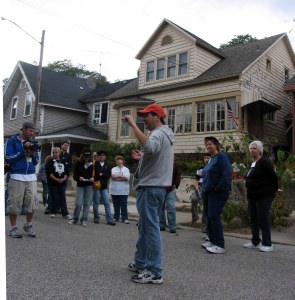 Ron Pesch, in orange cap, leads a tour of Damfinos on a walking tour of the Bluffton neighborhood where Buster Keaton spent summers of his youth. |
Ron was instrumental in convincing the
Community Foundation for Muskegon County to
purchase the statue of Buster that originally
stood outside of the Hollywood Entertainment
Museum in Los Angeles.
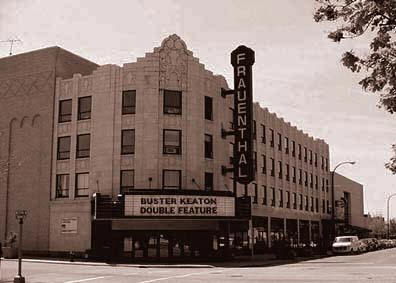
The sculpture is now at home in front of the Frauenthal Theater in downtown Muskegon. Buster’s daughter-in-law Barbara Talmadge and granddaughter Melissa Talmadge Cox were on hand for the Damfinos convention and unveiling of the plaque to accompany the statue.
 |
|
||
| Damfinos pose with
the statue of Buster that was relocated from Hollywood to Muskegon. |

If you’re asking yourself, “What are Damfinos?” I can tell you from my brief encounter this weekend that they are a fun bunch of musicians, accountants, students, performers, writers and others from across the U.S. and other lands who share a passion for the genius of Buster Keaton, in front of and behind the camera.
Check out the website of the official International Buster Keaton Society, aka Damfinos.
If you’re wondering how to pronounce Damfino, imagine the answer to the question, “What will be this week’s winning lottery numbers?”
|
NOTE: During the convention Damfinos viewed and voted on montages of movie clips of Buster Keaton’s incredible stunt work put to music, all produced by fans. It was a treat to see the variety and professionalism of the montages, assembled for the love of Buster. Click to see the winner, Hooked on a Can Can and Buster Keaton. Visitor Info Clicks: Muskegon Travel Michigan: Pure Michigan |
Bridal run held in Muskegon
by Jon Mills
 MUSKEGON,
Mich. (WZZM) - A movie scene made famous by Muskegon
native Buster Keaton played out on the lakeshore Friday.
The bridal run is best known from Keaton's movie "Seven
Chances."
MUSKEGON,
Mich. (WZZM) - A movie scene made famous by Muskegon
native Buster Keaton played out on the lakeshore Friday.
The bridal run is best known from Keaton's movie "Seven
Chances."
More than two dozen ladies and a Keaton look-a-like ran from the Tourism Depot to the Frauenthal Theater Friday afternoon. The event was meant to draw attention to the annual Buster Keaton Film Festival this weekend.
Patricia Eliot Tobias with the International Buster Keaton Society says, "We are showing one that was just re-discovered a few years ago called 'The Cook.' Then one of his most popular shorts called 'Cops.' Then 'Seven Chances' that has the bridal scene in it."
The Keaton film "The Cook" was recently found in the attic of a former hospital in Norway.
Recently, the International Buster Keaton Society held its convention in Muskegon. As part of the convention activities, the group re-enacted the chase scene from Seven Chances – a movie in which Buster Keaton’s character must be married to inherit millions from his grandfather’s will.
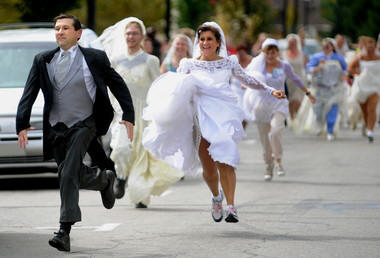 |
Francine Sagan a fitness specialist at Tanglewood Park, right, is in hot pursuit of Buster Keaton look-alike as they run down W. Western Avenue in downtown Muskegon Friday afternoon. A group of "brides" were part of a re-creation of one of the most famous scenes in all of Buster Keaton's films - - the bridal run in "Seven Chances". The run was the kick off for the 16th annual Damfinos convention. Buster Keaton's biggest fans are members of The International Buster Keaton Society which are nicknamed the Damfinos. |
Damfino convention will get off to a running start
Published: Tuesday, September 28, 2010
As many as 50 devotees of everything Buster Keaton — from his timeless films to his time growing up in Muskegon and as a Hollywood star — will gather here this weekend for the 16th annual Damfinos convention.
 |
And this year, they’ll be wearing bridal veils. At 1:30 p.m. Friday, the Damfinos will attempt to re-create one of the most famous scenes in all of Keaton’s films — the bridal run in “Seven Chances” — to officially kick off the convention at the Muskegon Historic Union Depot, 610 W. Western. Just like in “Seven Chances,” a stampede of brides will be in hot pursuit of Keaton, or at least his look-alike. Members of the public are invited to join in, says Ron Pesch of Muskegon, a board member of the International Buster Keaton Society and local historian. Although Keaton is most often connected with Muskegon’s Bluffton neighborhood, the Damfinos always convene at the railroad station, Pesch says. |
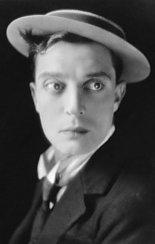
| Buster Keaton |
Buster Keaton’s is a familiar story to many in Muskegon. The silent-film giant spent his summers as a child from 1908 to 1917 in the Bluffton neighborhood on Muskegon’s west end. His father, Joe Keaton, built a cottage on Muskegon Lake in 1908 in what became
 The
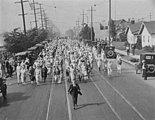
group will re-enact the famous bridal run scene from
Keaton's film "Seven Chances."
The
group will re-enact the famous bridal run scene from
Keaton's film "Seven Chances."“The best summers of my life were spent in the cottage Pop had built,” Keaton wrote in his autobiography.
Born Joseph Frank Keaton on Oct. 4, 1895, the boy was soon nicknamed “Buster.” He reportedly made an unexpected appearance when he was still in diapers, crawling onstage from the wings to get to his dad. He formally joined their vaudeville act when he was only 3 years old.
Keaton is considered one of the most talented comic actors and directors of his time. He was nicknamed “The Great Stone Face,” because of his trademark deadpan expression. Although he appeared in “talkies” and even on television, Keaton was most comfortable, and appreciated, in the silent film era. He died in 1966 at the age of 70.
Since 1994, some of his biggest fans — members of The International Buster Keaton Society, nicknamed the Damfinos — come to Muskegon from all over the country to celebrate his life. The convention is held each year around his birthday. Damfino was the name of a boat Keaton built in the film, “The Boat,” and a play on the film’s punchline: “Damned if I know.”
| IF YOU GO | ||
|
• What: 16th Annual Damfinos Convention • Who: The International Buster Keaton Society • When and where: Friday and Saturday at sites around Muskegon • Public showing: “Seven Chances” and two other Keaton films (“The Cook” and “Cops”) will be shown 8 p.m. Saturday at the Frauenthal Center for Performing Arts, 425 W. Western. Tickets are $6 or $20 for a family up to five. Available at the Frauenthal Box Office, 727-8001. • Information: silent-movies.com/Damfinos |
||
While in Muskegon, society members play baseball at Bluffton School where Keaton played as a child. They take a historic tour, led by Pesch, of the Bluffton area, visiting Keaton’s old haunts. They watch his films and invite those with special insight into the man and the movie star.
This year, special guests include Barbara Talmadge, Keaton’s daughter-in-law, and Melissa Talmadge Cox, his granddaughter. It is Barbara Talmadge’s first trip to the convention.
In addition, Bart Williams, one of Keaton’s former neighbors in California, will present the program, “The Art of the Pratfall,” and a concert of Buster Keaton’s songs. Organist Dennis Scott, president of the Chicagoland Theatre Organ Society, will accompany the films.
Besides “Seven Chances,” which was filmed in 1925, the society will also show “Cops” (1922) and “The Cook” (1918). All three films will be presented at a public showing at 8 p.m. Saturday. Proceeds will be donated to the Frauenthal.
The public response to Keaton’s work — filmed in black and white, and silent, of course — is nothing short of stunning, Pesch says.
“When’s the last time you saw an audience stand up and applaud at a film?” he asks. “That’s what happens here. This is rare stuff, and we have it in Muskegon. Normally, you’d have to go to New York or Los Angeles to see these films.”
While in Muskegon, the Damfinos will dedicate a life-size bronze statue of Keaton outside the Frauenthal Center for the Performing Arts, Pesch says. Earlier this year, the Community Foundation for Muskegon County purchased the statue for $22,000. It was previously on display at the Hollywood Entertainment Museum in California.
Pesch calls the statue and town “a perfect fit.”
“When you know he lived in Muskegon and how much he loved it, you watch his films a little differently,” says Pesch, who co-authored the local history book, “Buster Keaton and the Muskegon Connection.”
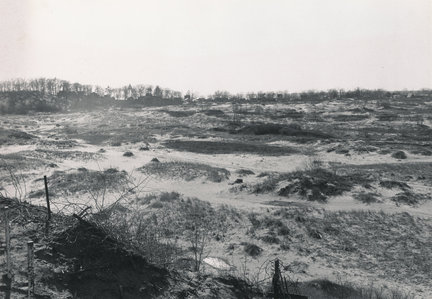
“You see the influence: the ships, the boats and trains, the water, how he rolls down sand dunes like he did as a kid on Pigeon Hill,” Pesch says. “It’s really quite wonderful to be able to showcase all that here, in Muskegon.”
Susan Harrison Wolffis is a Chronicle correspondent.
Saving downtown — from itself
Published: Sunday, September 19, 2010
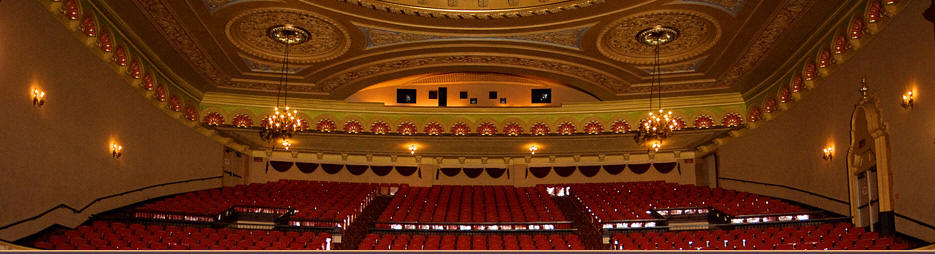
The truth is, we were this close in the mid-1970s to knocking down the Michigan Theater, the gorgeous space we now know as the Frauenthal Theater in downtown Muskegon.
Thirty-odd years ago, the wrecking ball was poised and ready to swing in the name of urban renewal, aimed directly at the big old theater standing on the corner of Third Street and Western Avenue.
The plan was well-intentioned, even if in some people’s minds, misguided. Others called it progress.
Down went the Occidental Hotel, the Regent Theater (which some insist was even more beautiful than the Michigan), the uniquely shaped Flatiron Building, little shops like Newmode Hosiery and big department stores like Grossman’s that once lined Western Avenue.
For awhile, it was like being in a demolition derby downtown, everything smashed and destroyed, piles of rubble left behind. The idea was out with the old, in with a new and covered mall on what once was the community’s main street: Western Avenue. To be fair, it was considered cutting edge architecture at the time, enough that it drew national attention in urban renewal circles.
City officials from across the country came to see what Muskegon was doing, how it was resurrecting and reinventing its downtown, which had faded from glory as people moved into the suburbs — away from the urban center.
In one plan, a parking lot was needed where the old Michigan Theater, which had fallen on bad times in the 1960s and ’70s, stood. Built in 1930 at the height of the Depression, the theater was a sorry sight. No one disagreed that it had seen better days aesthetically or that it had lost the bulk of its clientele to newer, more modern movie theaters.
But there was a group of people in town, a coalition of historic preservationists, civic-minded citizens and emerging philanthropists, who put their collective feet down, and said: No, not this one. Not the Michigan. This one stays.
As the reporter who covered the arts beat in those days, I interviewed people who stood emotionally and physically in front of the wrecking ball — grandmothers who loved old buildings, guys who saved houses that became Heritage Village downtown, men and women who had too memories connected to the theater to see it go.
 They
saved the Michigan Theater from certain destruction. It
was a heroic effort, but their work wasn’t done. The
Community Foundation for Muskegon County, an emerging
organization, used $475,000 of a $1.5 -million gift from
Muskegon industrialist Harold Frauenthal to buy not only
the theater, but the entire block from Third to Fourth
streets on Western Avenue.
They
saved the Michigan Theater from certain destruction. It
was a heroic effort, but their work wasn’t done. The
Community Foundation for Muskegon County, an emerging
organization, used $475,000 of a $1.5 -million gift from
Muskegon industrialist Harold Frauenthal to buy not only
the theater, but the entire block from Third to Fourth
streets on Western Avenue.
Together, the foundation and those willing to defy the wrecking ball saved a piece of Muskegon’s past.
In an unprecedented move, members of the town’s labor unions volunteered their time and expertise to transform what became the Hilt Building next to the theater into classrooms, meeting spaces, an art gallery and small theater.
Because of them, and more grants from the Community Foundation, the Frauenthal Center for Performing Arts rose from what could have been rubble.
The theater would need saving again. In 1995, the residents of Muskegon County voted to help fund a $7.5-million renovation of the theater and bring it back in all its historic glory.
This weekend, the Frauenthal is celebrating its 80th anniversary, a testimony to what a community can do when its people decide to preserve its past. The irony, of course, is that in doing so — in saving a bit of history — we secured our future.
Once again, downtown Muskegon is rising up, reinvented and resurging. And its cornerstone? The place that brings thousands of people through its doors every year?
That theater some people wanted destroyed, all in the name of progress.
Susan Harrison Wolffis is a Chronicle columnist. E-mail: susanharrisonwolffis@yahoo.com
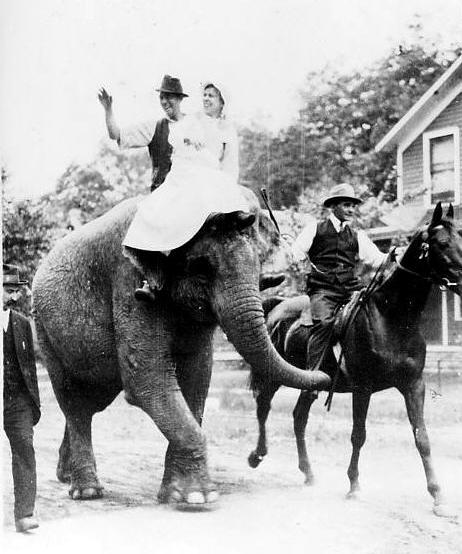
Joe and Myra Keaton, parents of movie comedian Buster Keaton, ride on an elephant in Muskegon, circa 1915.
It was a fairy tale come true, at least for a child of vaudeville performers.
“The best summers of my life were spent in the cottage Pop had built on Lake Muskegon in 1908.” Famed silent film comedian Buster Keaton wrote those words in his autobiography, My Wonderful World of Slapstick. For the Keaton family, which then numbered five, Muskegon, Michigan was a place to call home.
“It was his favorite place on earth,” noted Keaton’s widow, Eleanor, years later. “He loved Muskegon.”
The Childhood of Buster Keaton
Born on the road in a little Kansas town in 1895, Joseph Frank Keaton had known only one life. Before the age of three, he was incorporated into the family act. By age five, he had become a regular and would soon be the feature member of “The Three Keatons.” It was a nomadic life filled with matinee and evening stage performances, travel, backstage banter, and hotel stays in big cities and small burgs scattered across the countryside. For a child, the upbringing was far from normal.
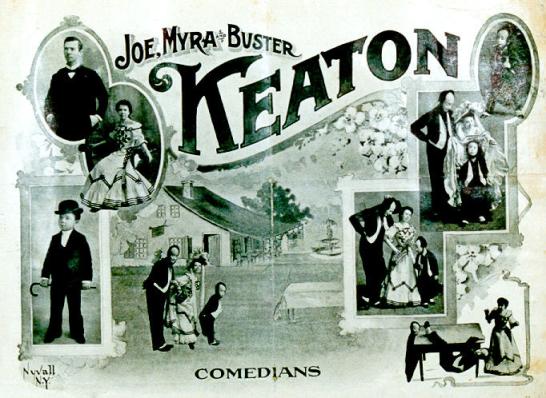
The Three Keatons – Joe, Myra and young Buster, Circa 1905
A booking in Muskegon would alter that life. While performing at the Lake Michigan Park Theater in July 1908, his parents, Joe and Myra, visited property that was for sale along the shore of Muskegon Lake. The Keaton’s arraigned a purchase, and then returned to the road, informing friends and acquaintances of the little slice of paradise they had found in Muskegon, Michigan.
The Actors’ Colony
The move laid the groundwork for a thriving community of actors that grew in Edgewater and the neighboring Bluffton area. It was known as the Actors’ Colony and thrived during the summer months, when performers relaxed as bookings on the vaudeville circuit were down due to the heat.
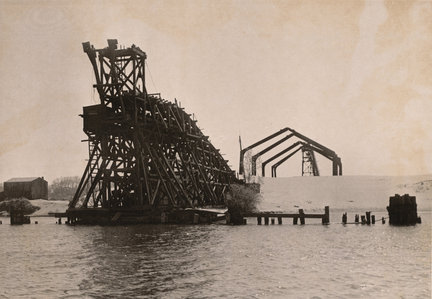
With Pigeon Hill, a soaring sand dune, serving as a backdrop, Joe had a cottage built for his family on a lot that faced the water. For Buster, his sister Myra and his younger brother Harry (nicknamed Jingles because of his “noisy way with toys”), Muskegon provided a chance to be kids.
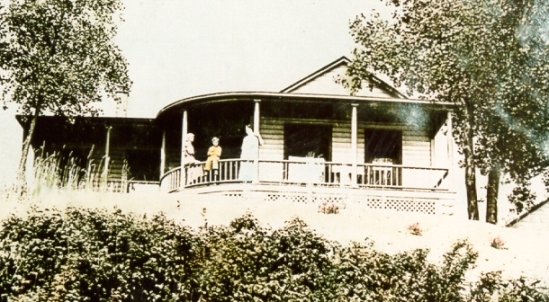
The Keaton cottage in Muskegon. The Keatons moved to Muskegon in 1908, and this house was taken down in the 1950s.
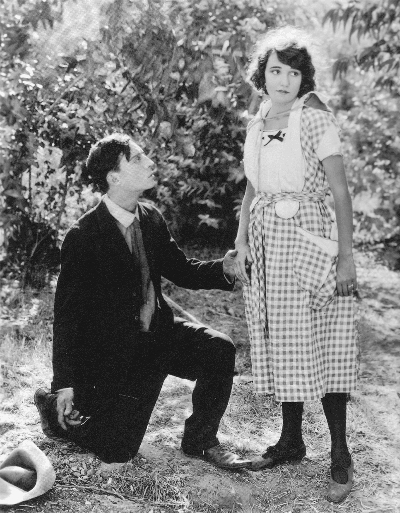
Buster Keaton and Sybil Seely in The Scarecrow, 1920
A “True Playground for Residents”
Populated with a cast of regulars and an ever-changing collection of visitors, word is that the area served as home to over two hundred performers at its peak years. It was a true playground for residents.
Fishing, swimming and boating were, of course, favorite pastimes. A short walk away was Lake Michigan Park, featuring a theater, carnival amusements, dancing and fun (For images, click Lake Michigan Park images). Pascoe’s Place, located near the turnaround for the streetcars that brought visitors to the Park, sat nearby. Serving as the unofficial headquarters for the Colony, the menu featured succulent pan-fried perch and nickel beers. A baseball diamond situated behind the property came alive with contests against local factory squads.
Max and Adele Gruber lived just down the street. Their novelty animal act, “Oddities of the Jungle” featured the talents of an elephant, a trained zebra and a Great Dane. Max’s elephant, it is said, was often dispatched to provide taxi service for the reveler who enjoyed a little too much of his drink of choice at Pascoes.
Living next to the Keaton’s was Big Joe Roberts, who would later serve as the heavy in Keaton’s films. Ed Gray, known as the “Tall Tale Teller,” was also a friend of the family’s. Annoyed by regular visits to his property by patrons of the nearby Park, he dispatched Buster’s talents in building an outhouse with collapsible walls. With a yank on a rope, Gray could quickly identity trespassers, to the amusement of many.
Lex Neal, a peer, became fast friends with Buster, and later served as a writer in Hollywood for both Buster and silent-film comedian Harold Lloyd.
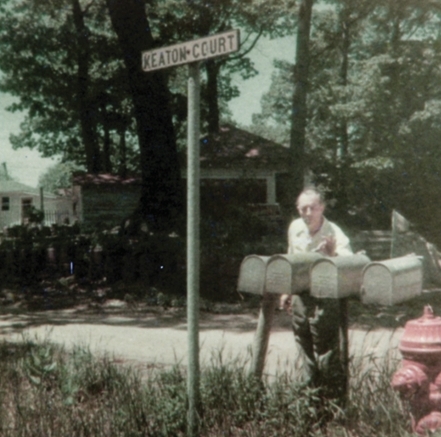
An older Buster Keaton at Keaton Court, a street in Muskegon. Photo taken circa 1949.
Legacy
Today, the delight of lakeside living is still enjoyed in similar ways by residents of the area. The neighborhood’s storied past is celebrated the first weekend of October each year when the International Buster Keaton Society descends on Muskegon for their annual convention. A visit to the baseball diamond, a trip through the neighborhood and discussions on Buster’s years as a performer are capped with a public showing of some of his classic comedies at the city’s restored movie house, the Frauenthal Theater. Featuring the sounds of a booming Barton theater organ, the theater’s silver screen glistens with Keaton’s antics, and is filled with fun and laughter – a fitting tribute to a man who, according to film critic Roger Ebert, is “arguably, the greatest actor-director in the history of movies.”
Our Guest Blogger
Ron Pesch, an IT worker, has written for Michigan History Magazine, MLive and other publications. He is an historian for the Michigan High School Athletic Association, a board member of the International Buster Keaton Society and a die-hard high school sports fan. He graduated from Muskegon High School and Western Michigan University.

That Was Hollywood
Museums about Hollywood history must compete for visitors with movie back lots and celebrity-home bus tours, and have trouble gaining traction. A museum in Hollywood devoted to Max Factor’s beautification of stars lasted about a decade in the 1980s and ’90s, and the actress Debbie Reynolds has been trying for years to set up her Hollywood Motion Picture Museum in Tennessee after plans for a Los Angeles site fell through.
The Hollywood Entertainment Museum, which opened in 1996 on Hollywood Boulevard and took on the Max Factor collection, closed four years ago and is now auctioning off much of its contents. The sales will help finance the museum’s current focus: education programs in entertainment-industry skills for at-risk youth. “The goal is,” said Phyllis Caskey, the museum’s president, “what can we do, and can we save us?”
Super Auctions in Huntington Beach, Calif., has held a half-dozen online and live sales for the museum so far and plans more in the next few months. The lots available now range from four photos of Errol Flynn dressed as a physician, miner and, of course, pirate ($75 to $150 for the set) to Max Factor’s “Beauty Calibrator,” a 1932 filigree metal hood used to detect facial flaws ($85,000 to $150,000).
Super Auctions has rented extra warehouse space near its office to sort through the museum’s thousands of objects. Melissa Storment, the company’s vice president, has been trying to research each artifact; on the back of a 1928 production still she found a sketch of Dopey signed “Dick F” that she has tentatively attributed to the animated film director Richard Fleischer. (Disney scholars said it did not come from one of that studio’s staff members.)
She is also trying to market the material to other nonprofit institutions. This spring a Michigan foundation paid $22,000 for a life-size bronze statue of Buster Keaton that stood beside the museum’s Hollywood Boulevard entrance. The statue was re-erected a few weeks ago outside a 1929 Moorish Revival theater in Muskegon, Mich.; Keaton wears rumpled clothes and a porkpie hat while dwarfed by a movie camera.
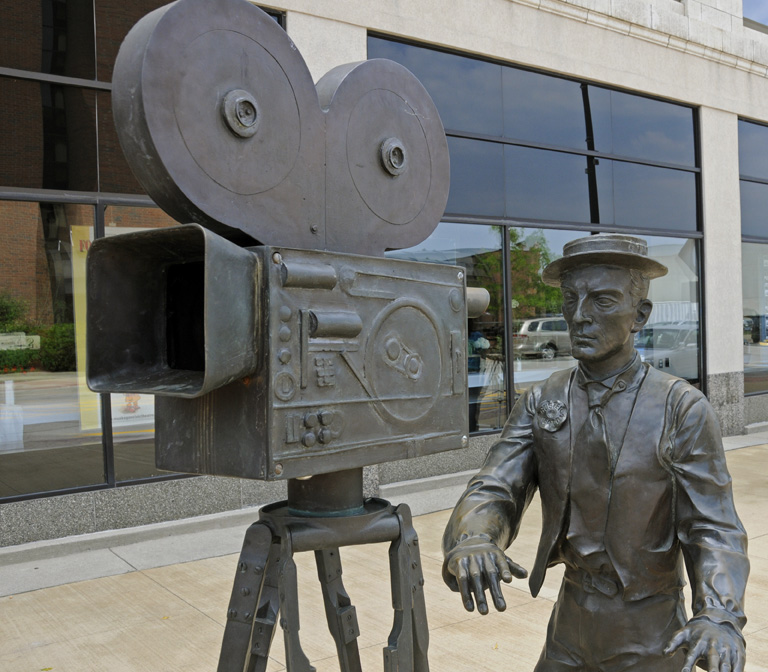 “I
think it’s fantastic that someone who comes to
Muskegon and walks around the downtown will bump
into this statue and realize, ‘Wow! Buster has
ties here,” said Ron Pesch, a Muskegon historian
on Buster Keaton. “Buster is widely considered
one of the absolute greatest directors in cinema
history.”
“I
think it’s fantastic that someone who comes to
Muskegon and walks around the downtown will bump
into this statue and realize, ‘Wow! Buster has
ties here,” said Ron Pesch, a Muskegon historian
on Buster Keaton. “Buster is widely considered
one of the absolute greatest directors in cinema
history.” 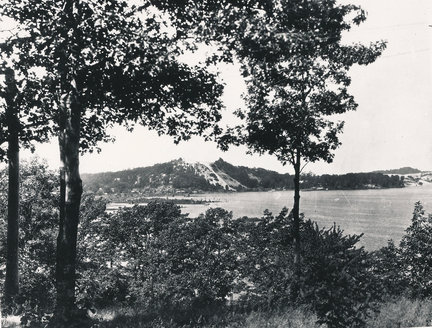

I just returned from Muskegon where I accompanied three Buster Keaton films at the Frauenthal Theatre on Saturday evening for the International Buster Keaton Society. On Saturday afternoon, the theatre unveiled a plaque honoring Buster Keaton, next to the bronze statue of him that was dedicated a few months ago. The theatre is a gem, designed by C. Howard Crane. Everything about the place is first rate. Stage director Bill Bodell and his crew embody the term “professional” and the stage area is the cleanest I’ve seen anywhere. Staging, lighting and projection are spectacular and the shows always run very smoothly. Jim Fles maintains the Barton organ, a 3 manual /16 rank (half are digital samples) and it sounds wonderful in the “Frau.” Anyone attending the conclave will fall in love with the Frauenthal. The locals are very friendly and they take much pride in their theatre. This was my fourth year playing for the Keaton group, known as the Damfinos, and it is one of my favorite events each year. Today, October 4th, would be Buster’s 115th birthday and the group meets in Muskegon because that’s where he spent his summers as a youth. For theatre organ fans, today would also be John Muri’s 104th. John played at the Frauenthal several times during the 1970s and 80s