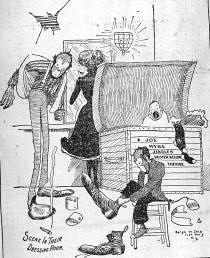
The Keatons
|
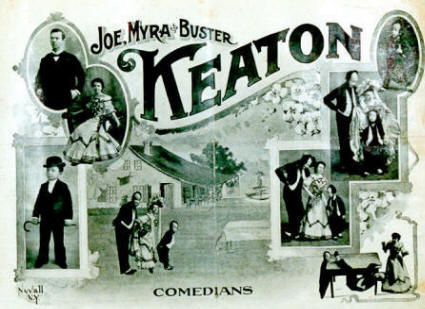
Joseph Hallie Keaton Born: July 6, 1867, Dogwatch, Indiana Died: January 14, 1946, Los Angeles, CA |
Myra Edith Cutler
Keaton Born: March 13, 1877, Modale, Iowa Died: July 21, 1955, Los Angeles, CA |
|
Joseph Frank "Buster" Keaton
Harry Stanley "Jingles" Keaton
Louise Dresser Keaton |
|
 |
|
|
|
|
The deadpan look, legend has it, produced
greater laughs from the audience. According to the
International
Buster Keaton Society website, from his childhood on the road "Buster
learned not only to be his father's roughhouse partner, but to sing, dance,
play the piano and the ukulele, juggle, do magic and write gags and parody."
The skills would serve him well over a career that spanned the theater,
silent film, the "talkies", and television.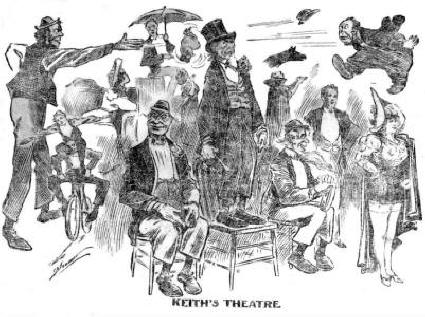 |
|
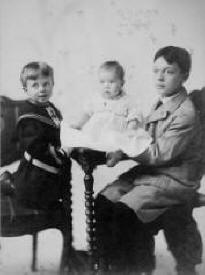 |
The
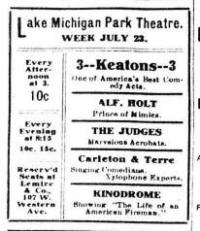
Keatons discovered Muskegon while performing at Lake Michigan Park
Theater in 1902 and 1905. Interested
in finding a place to settle down during vaudeville's off-season, Joe
Keaton, the patriarch of the family, became enthralled with the area. Bluffton offered recreation, an exciting and carefree atmosphere and a break from the constant touring associated with vaudeville. He liked the recreation offered by the lakes and the presence of other performers. |
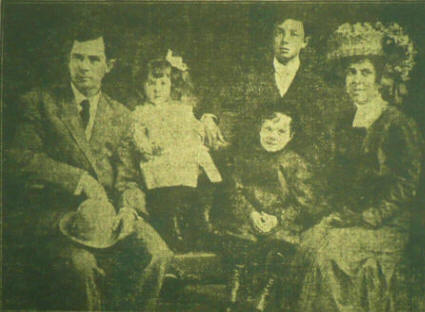 |
|
|
Together they could
relax, play and prepare for another season of life on the road.
For Myra, a passionate card player, the community offered an endless supply of pinochle partners. With a financial interest in some of the properties in Bluffton and the adjoining Edgewater area, Joe Keaton hit the road to sing the praises of the slice of heaven that he had found. The plan worked. Newspaper reports note that during the peak of popularity, nearly 200 vaudevillians would summer in the area. In 1908, the family had a cottage built at the edge of a massive sand dune known as Pigeon Hill, overlooking Muskegon Lake in a section of the city known as Edgewater. For young Buster and his siblings, Muskegon was indeed "home". |
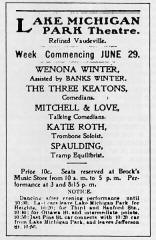 Advertisements
from 1902 (above) and 1905 (below) highlighting appearances by the
Three Keatons Advertisements
from 1902 (above) and 1905 (below) highlighting appearances by the
Three Keatonsat Muskegon's Lake Michigan Park Theatre . |
|
|
|
"Here Buster spent
eight idyllic summers," wrote Tom Dardis in his biography,
Keaton - The Man Who
 Wouldn't
Lie Down. "Like Earnest Hemingway, who also spent childhood
summers on a lake in Michigan, Buster early became an extremely
proficient duck hunter and skillful fisherman." Wouldn't
Lie Down. "Like Earnest Hemingway, who also spent childhood
summers on a lake in Michigan, Buster early became an extremely
proficient duck hunter and skillful fisherman." |
|
|
The
teenage vaudeville star's life-long love affair
with baseball developed during his days in Muskegon.
The summer months were also filled with exploration of Pigeon Hill, located directly behind the family
cottage. Boats and
swimming, of course, were a part of daily life at the Colony.
|
|
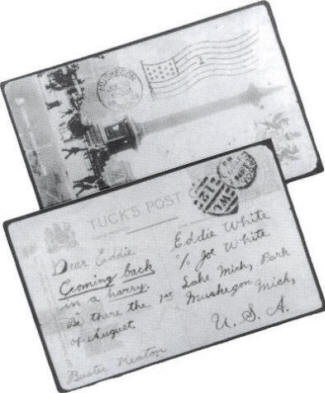 A postcard from young Buster to a friend from the Colony, Eddie White in Muskegon. "Dear Eddie, Coming back in a hurry. Be there the 1st of August." |
|
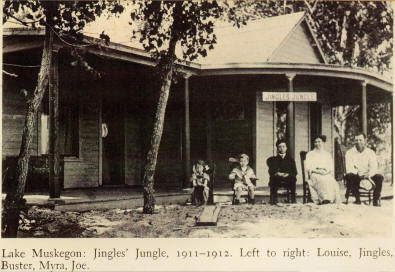 |
|
 |
"Buster tore into
each summer day as if doubting tomorrow," wrote Rudy Blesh in his
tale of the star's life, Keaton published in 1966.
"He tried every athletic sport and launched his lifetime avocation
of gadget building. His simplest Muskegon gadget was the Clown
Pole; the most complex, the Ed Gray Awakener..." "Buster's first brainchild, the Clown Pole, was only an old-fashioned bamboo fishing pole stuck upright between two planks of the Bluffton pier, as if its owners had just stepped into Pasco's for a beer. It had no reel, only a line that led |
|
down
to the water and a red cork bobber. However,
instead of ending in the usual way with hook and bait, the line ran
back underwater, around a pulley under the pier and then up and
through a window of The Cobwebs and Rafters." "The Clown Pole just stood there," wrote Blesh, "none of its chicanery visible. No stranger could ever just walk by it. He would hesitate, stop, stare at the pole, while actors covertly watched him from the clubhouse. One would grasp the line inside, twitch it gently, stop, then twitch it again. The stranger would invariably seize the pole, and prepare to land |
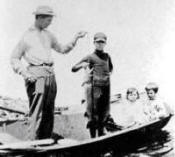 Joe
and the family on Muskegon Lake. Joe
and the family on Muskegon Lake. |
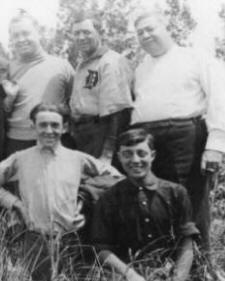 Back row (L to R): "Fat" Thompson, Joe Keaton (note the Detroit Tiger jersey), Tom Carmody. Front row (L to R): Lex Neal, Buster Keaton. Back row (L to R): "Fat" Thompson, Joe Keaton (note the Detroit Tiger jersey), Tom Carmody. Front row (L to R): Lex Neal, Buster Keaton. |
a fish. The 'battle' would start. A crowd would
gather and begin offering advice and encouragement. The upshot, of
course, was foredoomed: the actor in the club yanking the pole right
out of the stranger's hand, the crowd beginning to laugh, and the
victim standing flat-footed and gaping. But the pole was friendly
not cruel - the victim was invited inside and pinned with a wooden
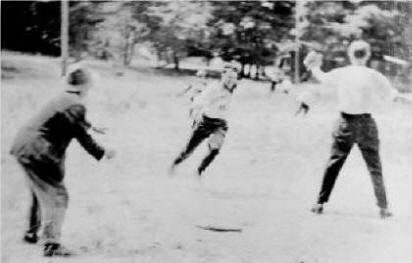
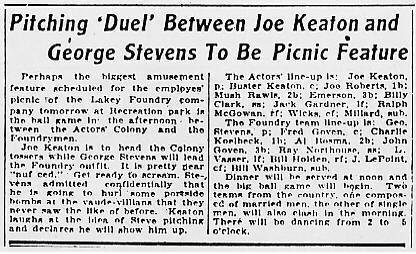
medal. True, he bought drinks for all." Baseball was a favorite pastime in the Colony, and Actors' Colony clubs would often square off against local factory squads. Line-ups changed on a regular basis, but usually included Joe and Buster, Joe Roberts, Mush Rawls, Billy Clark, Lex Neal, who was two years older then Buster, and local friend Keith Krueger, who's father Earnest had been a star catcher on Muskegon area teams before the turn of the century. |
 |
|
 |
|
| In January
1917, Buster left the family act, and as fate would have it, his
summers in Muskegon. In a few short months, he would appear in his
first film with Roscoe "Fatty" Arbuckle, The Butcher Boy. The family stayed in Muskegon while Buster's new career became established. Jingles and Myra attended school, while Joe worked in a local munitions plant to aid the war effort. Called to duty by the U.S. Army, Buster returned to Muskegon for a brief stay following his discharge in 1919. Soon after, the family left Michigan for California. While it is unknown if Keaton ever visited Muskegon with his first wife, Natalie Talmadge, he did return to his adopted hometown in 1933. With his second wife, Mae Scribbens, brother Harry and the family's "huge St. Bernard dog" in tow, the group arrived via chartered plane from Chicago. |
|
 He returned again in June of 1949, with his third wife,
Eleanor Norris. Preparing for a summer theater circuit performance
of "Three Men on a Horse", they were headed to Boston, but would
stop by Muskegon en route. He returned again in June of 1949, with his third wife,
Eleanor Norris. Preparing for a summer theater circuit performance
of "Three Men on a Horse", they were headed to Boston, but would
stop by Muskegon en route."It was home," recalled Eleanor nearly fifty years later. "He always referred to the city that way. It was a place to get out of the starched collars and into a tee shirt - a place to go barefoot. He had a wonderful time." Stopping by Pascoe's for perch and beer, he then spent the evening visiting with friends at the Muskegon Elks Club, where he had held a life membership. The couple returned to Bluffton in the early morning, where Buster went fishing. A walking tour of the old colony followed, then it was off to Boston. Despite plans to return, this would be his last trip home. In September of '49, Life magazine featured Keaton in an article on the clowns from the silent era. He had been rediscovered. |
|
| According to Eleanor, the next 17 years flew
by. In 1952, he was on television with a weekly show. The
rediscovery of his silent films led to numerous tours of Europe for
film festivals. In 1957, he was featured on Ralph Edward's This
Is Your Life television documentary show. Featuring guest
from the honoree's past, "Mush" Rawls, a friend from vaudeville and
member of the Actors' Colony who still resided in Muskegon made the
trip to California to reminisce. Muskegon was again remembered
as a new color television set was donated by the show to the local
Elks Lodge in Keaton's name. Buster returned once more to West Michigan, performing at the Ionia Free Fair in 1963. Less than 90 miles away from Bluffton, the touring schedule did not allow time for a trip home. Three years later, Keaton passed away. Eleanor, his widow, did return in to Muskegon in 1995 for the first International Buster Keaton convention. She returned numerous times before passing away in October 1998. |
|